
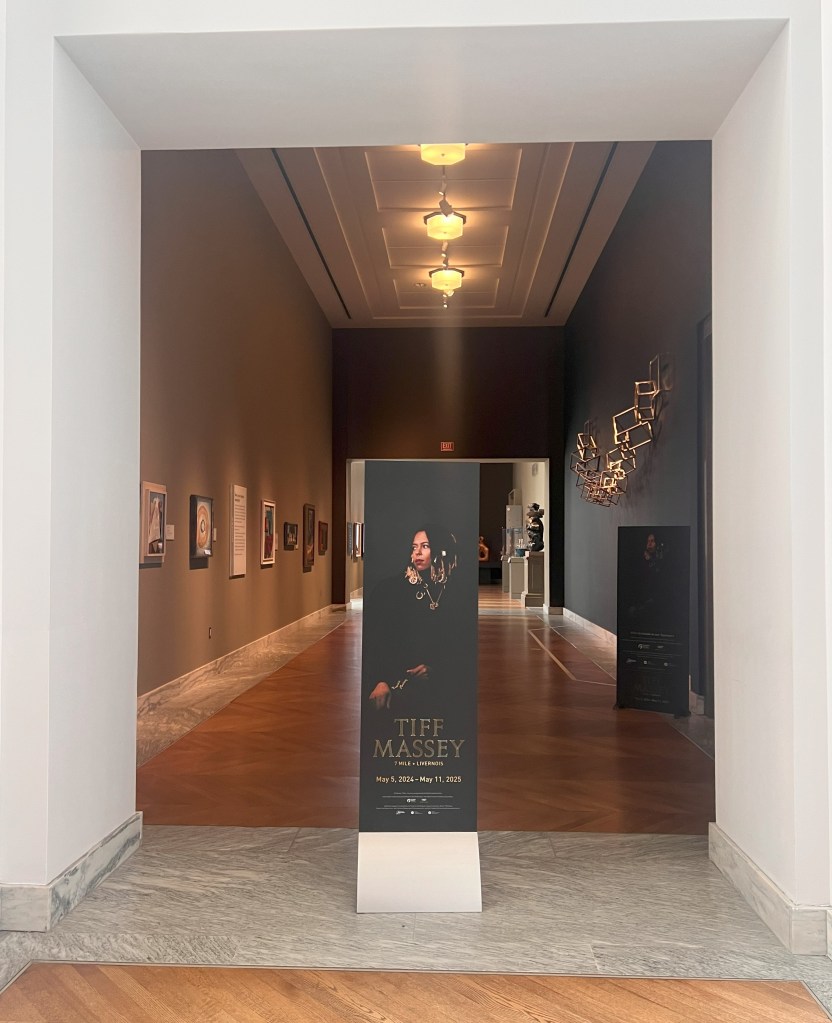
As much as I hate to admit it, sometimes my Instagram algorithm sends sentiments to scroll past that I actually enjoy. I don’t even know how Detroit entered the feed, but there it was — a post about a party at the Detroit Institute of Arts called 7 Mile + Livernois After Dark. Now… if you know me, I love a curated experience. I took the clickbait and was instantly sad I had missed the party, but more annoyed that I hadn’t been tapped into the announcement of the exhibit itself.
I’ll travel for art. So while in Detroit a few weeks ago, I made it a point to pop into the DIA and check out Tiff Massey’s current exhibit. Embarrassingly, I hadn’t visited the DIA since the 30 Americans exhibit nearly 10 years ago — and it showed. I didn’t carve out enough time for a proper reunion, but like most old art spaces, I was immediately reminded of the grandeur. And Detroit never shies away from an opportunity to showcase its Detroitness — I love that for them!
Housed in its current location since 1927 (though founded in 1885), the Beaux-Arts-style building — expanded a few times — holds 140 galleries, an auditorium, a lecture hall, a library, and concession spaces.
But on this day? I had a one-track mind… Straight to Massey’s exhibit…Four galleries…Two loops through the work: one to read and stare, the other to revisit my favorites and find the FeelSpace.
On display through May 11th, Massey’s exhibit evoked many childhood memories. Juxtaposed in a grand space — from the jump — I felt seen. But not just seen: understood, and preserved. Like being on your grandparents’ porch. Titled 7 Mile + Livernois, after the intersection that serves as the Black Business and Fashion District — and where Massey herself grew up — the exhibit was layered with meaning and magic that encouraged a meander through the space.
It may be my architecture degree.
It may be my “artsy-fartsy” interests.
It may even be because I’m Black.
Either way, instead of navigating this gallery with Google in hand, I knew the objects, and the intent and the references, about those.
First of all… I liked that there was a reference.
Second, I liked that I got the reference.
And third! I appreciated that I didn’t have to work hard or think outside of myself to gain access to it. I hope that was the intent.
And while I didn’t need the explanation, each piece had a personal note to the Detroit reader. A reminder that… this was for them. (I’m a Clevelander, so I’ll let y’all have your moment.)
It was very local, — but beyond that, the care in the creation of these pieces evoked something greater. A global reach. A reach rooted in representation, presence, and celebration — of culture, of nuance, of memory. I would advocate that her work is bigger than Detroit. The breath of the content may have skirted from the intersection… but it strolls down I-75, swings into unapologetic memories, and spurs movement. The work extended beyond objecthood — claiming and occupying space, and more than that, sowing community (nods to the future work on the horizon).
Massey’s pieces, in exaggerated scale, commanded space. The use of reflective surfaces seemed to expand territory. And though the scale was large, I could still imagine them fitting in the palm of my hand. Because, for many of them, they once had. I once wrapped the ends of my hair strands around a barrette, waiting for that satisfying snap — like in I Remember Way Back When (2023). I once couldn’t quite get that ball thingy through the elastic on my sister’s ponytail — just like in Baby Bling (2023). I often drew little cube perspective sketches on the corner of my notebook pages when lectures were boring, like Whatupdoe, 2024. And even though there were museum-mandated “Please don’t step over the line” signs, her work whispered, “Come on girl, cross that boundary.” And seemingly, her work is and always has.

Massey’s history stems from a place of creation. Working at many different scales, doing the most, and pushing the narrative of expression forward. A Detroit native. A Cranbrook Academy of Art graduate (and the first Black woman to earn a metalsmithing degree there). Explorer. Maker. Artist. Developer. She checks many boxes — like most of us do — and in the most delightful way.
Growing up, Massey visited the DIA. In her show, it was really beautiful to see the visual influences from the museum linger on and show up, but now, in a critical critique conversing with her own works. She included the works of artists Donald Judd (Stack, 1969) and Louise Nevelson (Homage to the World, 1966) and each one sparked different steps to her responding pieces. And while some artists create to create (and there’s nothing wrong with that — I do it all the time), some artists create to impact.
It’s clear that Massey’s work is a call to the latter. Yes, the pieces can be appreciated at surface level. But the #IYKYK level? That gives life. And I loved that for my experience in the FeelSpace. This was the perfect reminder of why I chase art and the artisian as hard as I can. My only regret?
That I didn’t route my Uber straight to 7 Mile + Livernois after leaving the DIA.
That would have been cool.
I’ll be back doe.
mj
Anyways… If you want to read more about Massey’s work here are a few links to check out!
 FeelSpace Blog