
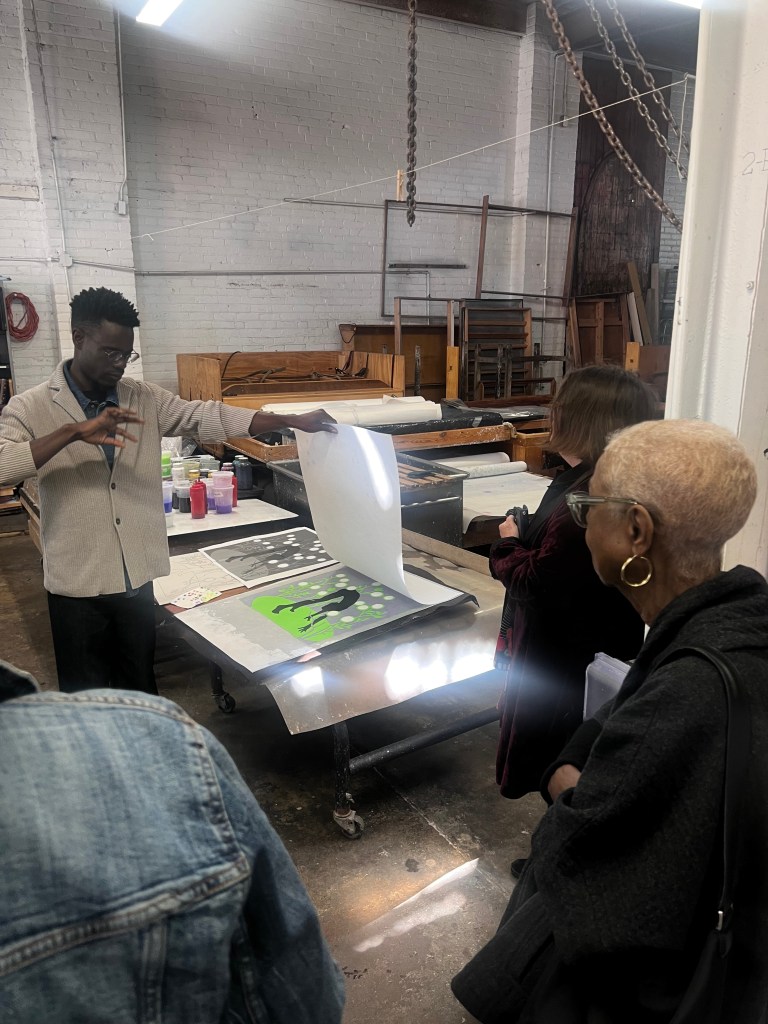
I’m often curious about when an artist explores another medium. How their visual language shifts when the known process changes. So when I received the invite to attend a small artist talk with Diedrick Brackens hosted by Cleveland Museum of Art’s Friends of African and African American Art affinity group, I was excited for the opportunity to get a glimpse into the new works. Brackens is known for his woven tapestries, often bold, abstract and symbolic, I wasn’t sure whether that same kind of movement could carry over into the handmade papermaking process.
Brackens’ work spans from figurative to abstract, and most of it lives in the world of textiles. He has a way of embodying motion in stillness. Whether in the posture of a figure or the rhythm of a woven color gradient, there’s something quiet but insistent in how his compositions move. It draws you in. It’s beautiful. And, for me, it’s especially striking in his abstract work (which, admittedly, I’m still having trouble choosing a favorite).
Using materials like woven cotton, nylon, and even tea or wine as dye, Brackens’ work feels like a meditation on both craft and memory. You get the sense that there is always exploring involved, pushing gently but deliberately at the boundaries of tradition.
Brackens recently spent some time in residence at Morgan Conservatory in Cleveland as part of its Collaborative Residency for Artists and Apprentices, funded in part by the National Endowment for the Arts. The grant was awarded before the NEA announced major cuts this spring and thankfully, it seems the Morgan-Brackens collaboration will still be fully realized. If you’ve never been, Morgan Conservatory is a hidden gem. It’s the largest arts center in the U.S. dedicated to papermaking, book arts, and letterpress. Tucked into a warehouse building on East 47th in Cleveland’s Hough neighborhood, it’s one of those places where the air feels rich with material and meaning. Founded in 2008, Morgan regularly hosts workshops, exhibitions, and residencies.
This residency was something of a real-life redo and a continuation of the connection Brackens first made with Morgan virtually during the pandemic. This time, Brackens was in Cleveland for a week, working with apprentices to create 20 works in total. While no stranger to printmaking, Brackens shared how the process of papermaking felt both different and complementary to the textile work. And of course, the use of cotton was non-negotiable. There’s overlap, even if the mediums differ. Bracken’s process still begins with drawing, and still pulls from collage. And the motifs, hands, figures, and the layered shapes remain connected to place, memory, and cultural reference. This time, though, they are manifesting on paper.
The new works in progress show a figure face-down, hands and feet pressed into the earth. It’s ambiguous: are they channeling something in, or drawing something out? Maybe both. Either way, it’s a landing. A grounding. A connection. In this medium, every color layer requires its own stencil, all created by hand, which, for Brackens, is essential. Working “in the wet,” as Brackens described it, adds another dimension of chance, mess, and materiality. We were able to see the paper pulp and two in-progress pieces during the visit. Watching them take shape was kind of mesmerizing… the care in placement… the patience of the process. The work had weight. Not just in content, but in material presence. I wasn’t sure how his signature sense of movement would translate from fiber to paper — but it did. Brackens use of a vibrant green base helped retain that sense of energy and visual charge. And the repetition of the process, maybe like the repetition of weaving imprints something new onto the work. Onto you, too. Some artists create just to create. And that’s valid. But others create to connect. To shift something in the world, or at least the room. Brackens’ work does that. It carries memory. It marks time. And still, it finds space to breathe. It’s beautiful work, but more than that it’s thoughtful.
mj
 FeelSpace Blog